5 Logic Games That Improve Critical Thinking
“Critical thinking” gets thrown around a lot, but in practice it means three things: spotting patterns, eliminating what’s impossible, and planning ahead. Logic games train all three — and unlike reading about critical thinking, they force you to actually do it under time pressure.
Here are five that do it well. All are free, browser-based, and require no account.
1. Minesweeper — elimination by counting
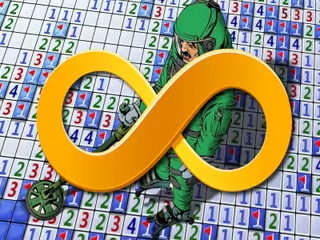
Minesweeper Infinite looks like a game about luck. It isn’t. Every number on the board tells you exactly how many mines are adjacent to that square. From those numbers you can deduce, with certainty, where mines are and where they aren’t.
The thinking is identical to Sudoku: eliminate what’s impossible, then see what’s left. Once you’ve played a few rounds, you stop guessing and start reading the board.
2. Sudoku — constraint satisfaction
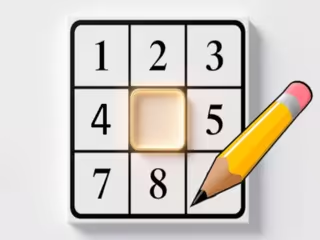
Classic Sudoku is the purest form of constraint-based reasoning. Every cell is limited by its row, column, and 3x3 box. A “naked single” is a cell where only one number can legally go. A “hidden single” is a number that can only go in one cell of a row, column, or box.
The skill you build here — scanning for constraints and eliminating candidates — transfers directly to scheduling, resource allocation, and any problem where multiple things have to fit together.
3. Gomoku — pattern recognition under pressure
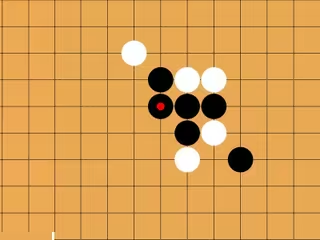
Gomoku is simple: get five stones in a row. But playing it well means recognizing threats before they form. You have to see three-move combinations while blocking your opponent’s.
This trains forward planning — the ability to simulate outcomes in your head before committing to a move.
4. Reversi — positional thinking
Reversi (Othello) flips the usual logic of board games: the player with fewer pieces often has the advantage, because every move flips enemy pieces to your color. Learning when to sacrifice position for future gain is a form of strategic thinking that applies well beyond games.
5. Dots and Boxes — risk calculation
Dots and Boxes looks trivial until you realize every move opens or closes options for your opponent. Skilled players deliberately give away small boxes to force larger chains later. It’s a lesson in calculated sacrifice — sometimes giving up a small win now prevents a bigger loss later.
How to actually get better
Playing one game once won’t do much. What works:
- Play the same game 10 times in a row. Pattern recognition comes from repetition.
- After each loss, ask why. Not “I was unlucky” — what specific decision led to the loss?
- Rotate between games. Different games train different parts of the same underlying skill.
Start with Minesweeper Infinite if you want pure deduction, or Classic Sudoku if you prefer a slower pace. Either way, the thinking habits you build will carry into everything else.