How to Play Chess: A Beginner's Guide
Chess has a reputation for being hard to learn. It isn’t. The rules fit on a single page, and you can play your first full game within 10 minutes of reading this. What takes years is mastering it — but that’s a different problem.
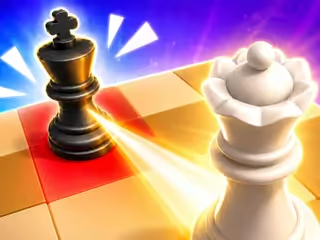
This guide covers the rules you need to start playing today. If you want to jump straight in, try Free Chess Move for a full game of classic chess, or Mate in Chess for short puzzles where you move pieces by their normal rules to trap the king.
The board and the pieces
Chess is played on an 8x8 grid of 64 squares, alternating light and dark. Each player starts with 16 pieces:
- 8 Pawns — move forward one square (two on their first move), capture diagonally
- 2 Rooks — move any number of squares horizontally or vertically
- 2 Knights — move in an L-shape (two squares one way, one square perpendicular) and can jump over pieces
- 2 Bishops — move any number of squares diagonally
- 1 Queen — moves like a rook and bishop combined
- 1 King — moves one square in any direction
The queen is the most powerful piece. The king is the one you must protect.
How a game starts
White always moves first. Most beginners open with one of these three moves:
- 1. e4 — a pawn to the center. Aggressive, opens lines for the bishop and queen.
- 1. d4 — also central, slightly more positional.
- 1. Nf3 — develops a knight, controls the center without committing a pawn.
You don’t need to memorize openings as a beginner. Just follow two principles: control the center and develop your pieces (get knights and bishops off their starting squares).
The three special rules
Three rules trip up almost every new player:
- Castling — the king and rook move at the same time. King moves two squares toward a rook, rook jumps to the other side. Only allowed if neither piece has moved and the king isn’t in check.
- En passant — if a pawn moves two squares and lands next to an enemy pawn, that enemy pawn can capture it as if it had moved only one square.
- Promotion — if a pawn reaches the far side of the board, it becomes any piece you want (usually a queen).
How to win
You win by checkmate — putting the opponent’s king in a position where it’s under attack and cannot escape. Not by capturing the king. The game ends the moment checkmate happens.
If neither side can checkmate (usually because too few pieces remain), the game is a draw.
Practice with a real board
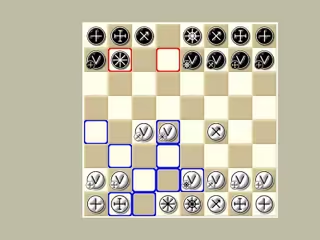
Reading the rules is one thing. Seeing how to trap a king is another. Mate in Chess turns that into short puzzles: each level gives you a position, and you move pieces by their normal rules to corner the king in the best way — a quick way to train pattern recognition. Once you’re comfortable, play full games in Free Chess Move. And when you want a twist, Tavreli: Russian Chess keeps the normal rules but stacks captured pieces into towers instead of removing them.
Start with one game. You’ll lose. Then play another. That’s how everyone learns.