How to Play Kakuro: Rules, Magic Sums and 5 Solving Tips
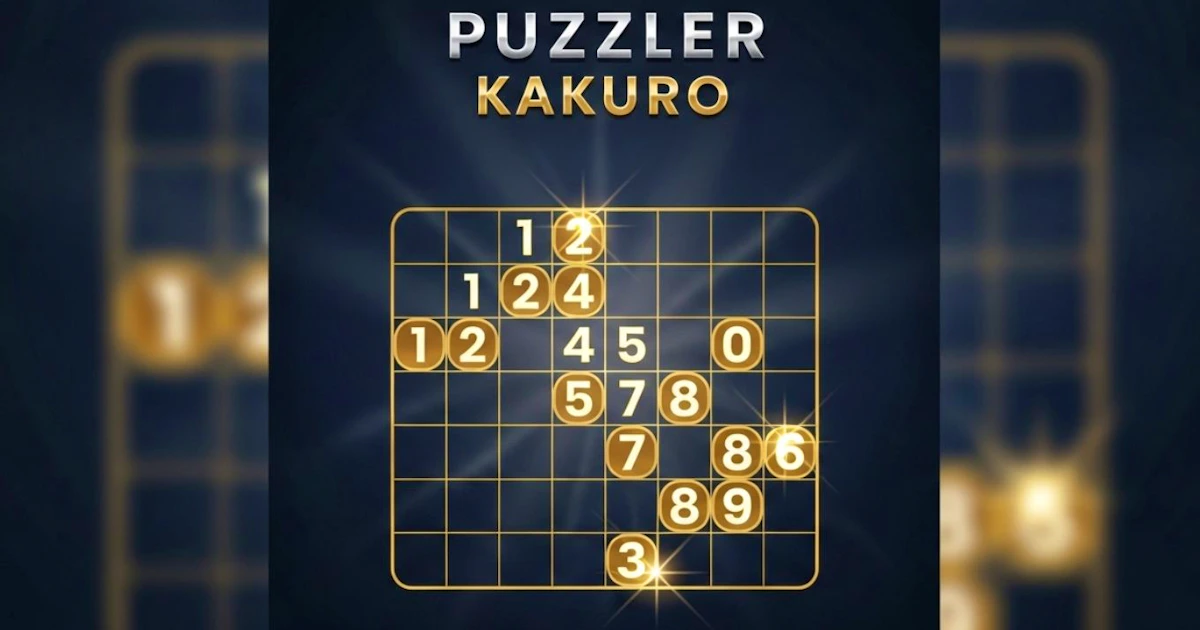
Kakuro is a number puzzle that works like a crossword made of sums. The grid has black cells with clues and white cells to fill. Each clue gives the total of the run of white cells next to it, and you fill those cells with the digits 1 to 9 so the run adds up to the clue, without using any digit twice in the same run. Every white cell sits in one run across and one run down, so each digit has to fit two sums at once. A well-made Kakuro has exactly one solution and never needs a guess.
You can try every rule in this guide in Puzzler Kakuro, which has Easy, Medium and Hard grids and plays in the browser on a computer or phone.
Quick answers
What are the rules of Kakuro?
Fill each white cell with a digit from 1 to 9. The digits in a run must add up to that run’s clue, and no digit may appear twice in the same run. That is the whole rulebook.
What do the two numbers in a clue cell mean?
A black cell split by a diagonal line can hold two clues. The number below the line is the total for the run going down from it; the number above the line is the total for the run going across to its right.
Can a number repeat in Kakuro?
Not inside one run. The same digit can appear many times in the grid, as long as it never repeats within a single across or down run.
Is Kakuro harder than sudoku?
It feels harder at first because it adds arithmetic, but it is not luck-based either. Once you know the handful of sums that can only be made one way, most grids open up quickly.
How to read the grid
- White cells are where digits go.
- Black cells are walls. Some carry clues, some are empty.
- A run is an unbroken line of white cells across or down. It ends at a black cell or the edge of the grid.
- A clue belongs to the run that starts right after it: to its right for an across clue, below it for a down clue.
So a clue of 16 next to two white cells means “two different digits that add up to 16”, and the only way to do that is 7 and 9. That one fact is the key to the whole puzzle.
The magic sums: runs that can only be made one way
Some totals have only one possible set of digits. Learn these and you will always have a place to start. The order of the digits inside the run is still for you to work out.
| Cells in the run | Total | The only digits that work |
|---|---|---|
| 2 | 3 | 1, 2 |
| 2 | 4 | 1, 3 |
| 2 | 16 | 7, 9 |
| 2 | 17 | 8, 9 |
| 3 | 6 | 1, 2, 3 |
| 3 | 7 | 1, 2, 4 |
| 3 | 23 | 6, 8, 9 |
| 3 | 24 | 7, 8, 9 |
| 4 | 10 | 1, 2, 3, 4 |
| 4 | 11 | 1, 2, 3, 5 |
| 4 | 29 | 5, 7, 8, 9 |
| 4 | 30 | 6, 7, 8, 9 |
| 5 | 15 | 1, 2, 3, 4, 5 |
| 5 | 16 | 1, 2, 3, 4, 6 |
| 5 | 34 | 4, 6, 7, 8, 9 |
| 5 | 35 | 5, 6, 7, 8, 9 |
The pattern is easy to remember: the smallest possible total for a run, and one more than that, can only be made one way; so can the largest possible total and one less. A run of all nine cells always totals 45 and uses every digit once.
Solving a run step by step
Say a cell sits in an across run of 3 in two cells and a down run of 4 in two cells.
- The across run must be 1 and 2, in some order.
- The down run must be 1 and 3, in some order.
- The shared cell has to be a digit both runs allow. The only digit in both {1, 2} and {1, 3} is 1.
- So the shared cell is 1, the other across cell is 2, and the other down cell is 3.
Almost every Kakuro is solved with this move: find where two runs cross and keep only the digits both of them allow.
5 tips to solve your first Kakuro
- Start with the magic sums. Scan the grid for the totals in the table above. Each one tells you exactly which digits are in play.
- Cross runs to pin digits. Where a run that must contain {7, 9} crosses a run that cannot contain 9, the crossing cell is 7.
- Rule digits out, not just in. In a two-cell run totalling 10 neither cell can be 5, because that would need 5 + 5. In a two-cell run totalling 15 nothing below 6 fits, because the other cell would have to be more than 9.
- Finish runs with simple subtraction. When all but one cell of a run is filled, the last cell is the clue minus the others. A run of 12 in three cells with 4 and 7 already placed needs a 1.
- Use pencil marks on harder grids. Note the possible digits in a cell and cross them off as the runs around it fill. On Medium and Hard grids this saves a lot of rubbing out.
Kakuro, sudoku and killer sudoku
- Sudoku has no arithmetic: each row, column and box holds 1 to 9 once. Our guide to solving sudoku faster covers the techniques that carry over.
- Kakuro has no boxes and runs of different lengths, and every run has a sum to hit.
- Killer sudoku sits in between: a normal sudoku grid with extra cages that each have a sum, so the magic-sum table above is just as useful there.
Where does Kakuro come from?
The puzzle first appeared in American puzzle magazines as Cross Sums. The Japanese publisher Nikoli later named it kakuro, short for kasan kurosu, “addition cross”, and it spread worldwide alongside sudoku in the 2000s.
Play Kakuro online
Start with an Easy grid in Puzzler Kakuro and keep the magic-sum table open the first few times. When you want a change, try picture logic with Color Nonogram Puzzle, a classic 9×9 grid in Classic Sudoku, or browse every puzzle type on our sudoku and logic puzzles page.