How to Solve Cryptograms: 7 Tricks + 3 Practice Puzzles
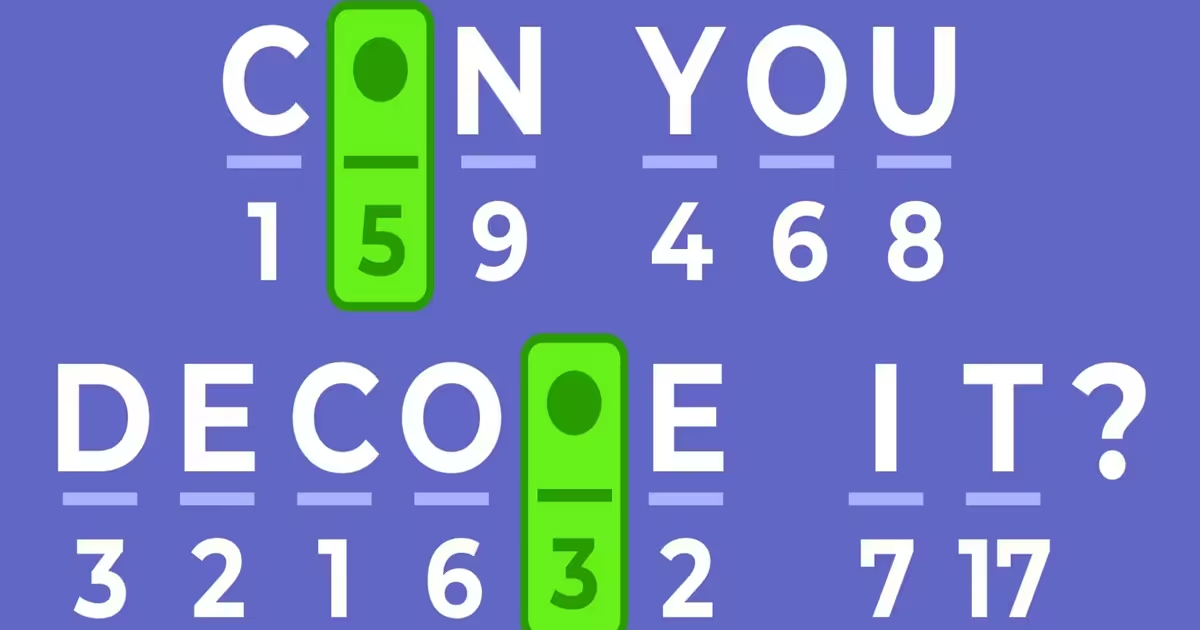
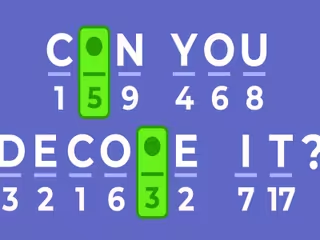
A cryptogram looks impossible at first: a line of numbers or scrambled letters that is supposed to be a sentence. But it is one of the most logical puzzles there is. Every symbol hides exactly one letter, English has strong patterns, and once you know where to look, a few correct guesses unlock the whole phrase. This guide explains how cryptograms work, the techniques that crack them, and ends with three practice puzzles (answers at the bottom). You can try everything here in our free Cryptogram game.
What is a cryptogram?
A cryptogram is a short piece of text written in a substitution code: each letter of the alphabet is swapped for another symbol, and the same letter is always swapped for the same symbol. There are two common styles:
- Number cryptograms replace every letter with a number from 1 to 26. This is the style used in the Cryptogram game on MathLogic.
- Letter cryptograms, like the “cryptoquotes” printed in newspapers, replace every letter with a different letter. In most published puzzles, no letter ever stands for itself.
Spaces and punctuation usually stay in place, which is a huge help: you can see how long each word is, where the apostrophes are and where sentences end.
Substitution codes are ancient, but cryptograms became a popular pastime in the 19th century. Edgar Allan Poe’s 1843 story The Gold-Bug even shows a character cracking one step by step.
The rules
- Each code symbol stands for one letter, and one letter only.
- The same symbol always means the same letter, everywhere in the puzzle.
- Two different symbols never stand for the same letter.
- Your job is to find the hidden phrase — usually a quote, a proverb or a fun fact.
Rule 3 matters more than it seems. Once you know that 14 is A, no other number can be A, which rules out a lot of guesses.
Seven techniques that crack most cryptograms
1. Start with one-letter words. A word made of a single symbol is almost always A or I.
2. Look at two- and three-letter words. The most common short words in English are small in number: of, to, in, it, is, on, at, be and the, and, for, are, but, not, you. A three-letter word that appears more than once is very often THE.
3. Use apostrophes. A single symbol after an apostrophe is usually S or T (it’s, don’t). Two symbols after one are often LL, RE or VE (we’ll, you’re, I’ve).
4. Spot double letters. Two identical symbols side by side are a double letter. The most common ones are LL, EE, SS, OO, TT, FF, RR and NN.
5. Count the symbols. The most frequent letters in English are roughly E, T, A, O, I, N. The symbol that appears most often in a long puzzle is a good candidate for E.
6. Look for repeated patterns. If a word has the same symbol in its first and fourth positions, like THAT or NOON, few English words fit. Write the pattern out and test it.
7. Fill in everywhere, every time. Each time you place a letter, write it in every spot where that symbol appears. Half-finished words then suggest the next letter on their own.
A worked example
Here is a number cryptogram of a well-known proverb:
14 · 21-13-8-8-18 · 6-14-17-13-11 · 1-6 · 14 · 21-13-8-8-18 · 13-14-22-8-13-11
(The dots separate words; the dashes separate letters inside a word.)
- Step 1 — the single number. The word 14 appears on its own twice. It must be A or I. Let’s try 14 = A.
- Step 2 — the repeated word. 21-13-8-8-18 appears twice and has a double symbol, 8-8. It’s a five-letter word with a double letter in the middle.
- Step 3 — the last word. 13-14-22-8-13-11 has the same number, 13, in the first and fifth places, and we know 14 is A. If 13 is E (the most common letter), the word reads E A _ _ E _. Words like EARNED and EASTER fit. Try EARNED: that gives 13 = E, 22 = R, 8 = N, 11 = D.
- Step 4 — check it. The repeated word becomes 21-E-N-N-18: PENNY, a real word, so the guess holds up. The two-letter word 1-6 and the word 6-A-17-E-D share the number 6. If 6 is S, they read IS and SA_ED — SAVED.
The answer: A PENNY SAVED IS A PENNY EARNED. Notice how each correct letter made the next one easier. That snowball effect is what makes cryptograms so satisfying.
Tips when you get stuck
- Guess in pencil. A wrong guess is normal. If a guess produces a word that can’t exist, like three identical letters in a row, undo it.
- Work on the longest known word. A long word with two or three letters filled in often has only one possible answer.
- Think about the type of phrase. Proverbs and famous quotes use everyday words. If the puzzle says it’s a quote, the last word or two might be the author’s name.
- Use a hint without guilt. In the Cryptogram game, one hint often breaks a logjam, and you still solve the rest yourself.
Why cryptograms are good for your brain
Solving a cryptogram is a steady mix of logic and language: you form a hypothesis, test it against the rules and keep only what fits. It’s the same deduction you use in Sudoku — every placement must be consistent with everything else — but with the extra layer of spelling and vocabulary. That makes cryptograms a great pick for older kids who are building reading skills, and a relaxing daily puzzle for adults.
Practice puzzles
Puzzle 1 (easy, number code). A saying about getting better at something:
7-12-10-23-18-26-23-8 · 16-10-14-8-4 · 7-8-12-25-8-23-18
Puzzle 2 (medium, number code). A proverb about getting started early. Hint: one three-letter word appears twice.
14-11-21 · 21-24-17-8-10 · 2-15-17-22 · 6-24-14-6-11-21-13 · 14-11-21 · 1-18-17-16
Puzzle 3 (harder, letter code). A proverb with apostrophes. Remember: no letter stands for itself.
CXGVG UXGVG’O L CQZZ, UXGVG’O L CLM.
When you’re ready for more, open the Cryptogram game for a new coded phrase every level, or try another word puzzle like Word Mosaic.
Answers
- PRACTICE MAKES PERFECT (7 = P, 12 = R, 10 = A, 23 = C, 18 = T, 26 = I, 8 = E, 16 = M, 14 = K, 4 = S, 25 = F)
- THE EARLY BIRD CATCHES THE WORM (14-11-21 = THE; 24 = A, 17 = R, 8 = L, 10 = Y, 2 = B, 15 = I, 22 = D, 6 = C, 13 = S, 1 = W, 18 = O, 16 = M)
- WHERE THERE’S A WILL, THERE’S A WAY. (C = W, X = H, G = E, V = R, U = T, O = S, L = A, Q = I, Z = L, M = Y)