Is Minesweeper Luck or Skill? 5 Patterns That End Guessing
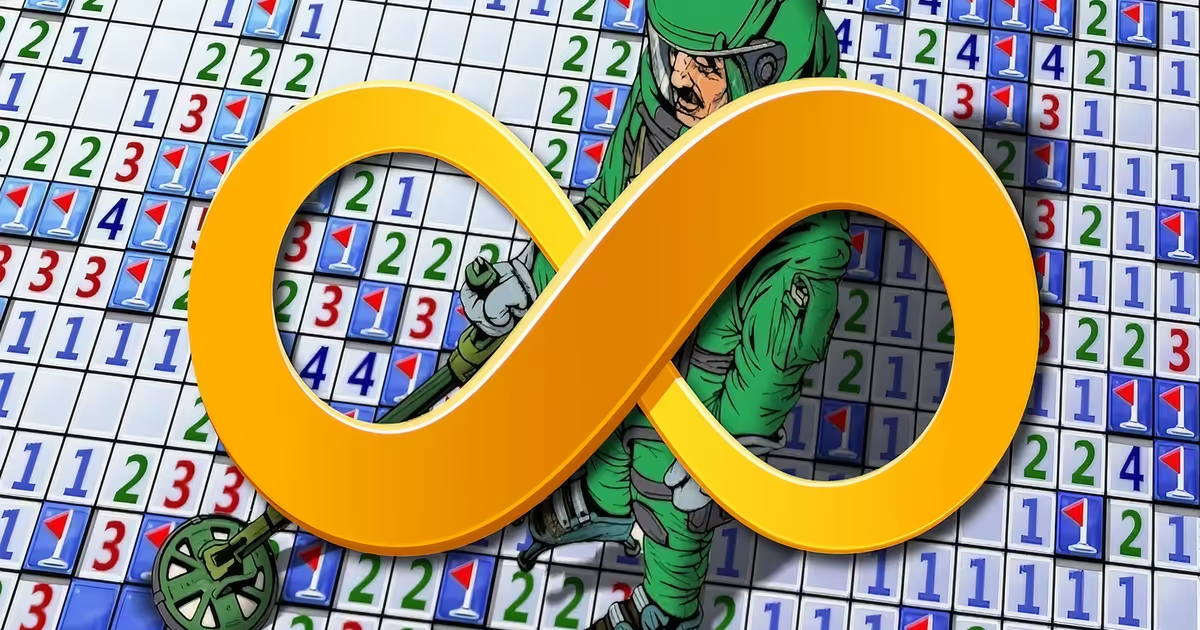
Minesweeper is mostly skill. On a typical board, the numbers tell you exactly where most of the mines are, and a careful player can open the majority of cells without a single guess. Luck shows up in only a few places: the first click, and the occasional spot where two cells look identical to the numbers. That is why good players win far more often than beginners. It is also why even the best players still lose some games on Expert.
Want to test it while you read? Open Minesweeper Infinite in another tab.
Quick answers
Is Minesweeper luck or skill?
Both, but mostly skill. Logic decides most of the board. Luck decides the opening and a few “coin flip” positions where no amount of thinking can tell two cells apart.
Can you win Minesweeper without guessing?
Not on every board. Standard Minesweeper places mines at random, so some boards force a guess. “No-guess” versions only create boards that can be cleared with logic alone.
Is the first click always safe?
In the classic Windows game, yes: if your first click lands on a mine, the game quietly moves it. Many modern versions go further and make sure the first click opens a blank area. Not every version does this, so check the rules of the one you play.
Why is Minesweeper so hard?
Partly density: an Expert board hides 99 mines in 480 cells, about one in five. And partly math: in 2000, Richard Kaye proved that checking whether a Minesweeper position is even possible is NP-complete. That puts it in the same family as some of the hardest problems in computer science.
What do the numbers mean?
A number shows how many mines touch that cell, counting all eight neighbours, diagonals included. A blank cell has no mines around it, which is why clicking one opens a whole area.
Where the skill is: patterns you can trust
Almost everything in Minesweeper comes from two simple rules:
- If a number equals its hidden neighbours, they are all mines. A 2 with exactly two unopened cells next to it means both are mines.
- If a number already has that many flags around it, every other neighbour is safe. In most versions you can click the number itself to open them all at once.
Combine those rules along a straight edge of hidden cells and a few patterns appear again and again. In the diagrams below, the top row is open numbers and the bottom row is the hidden cells directly beneath them.
1-2-1: mines under the 1s, the middle is safe.
 1   2   1
[*] [ ] [*]
1-2-2-1: mines under the two 2s, the ends are safe.
 1   2   2   1
[ ] [*] [*] [ ]
1-1 starting at a wall: the third cell is safe. The first 1 touches only two hidden cells, and the second 1 touches those same two plus one more. The single mine must be in the shared pair, so the extra cell is clear.
|1   1
|[ ] [ ] [safe]
Learn to spot these three and you will clear most Beginner and Intermediate boards with no guessing at all.
Where the luck is
Luck has only a few places to hide:
- The opening. Before any number shows, every cell is a guess. Corners are slightly more likely to open a blank area, because a corner has only three neighbours that need to be mine-free.
- True 50/50s. Sometimes two hidden cells share one mine, and no number anywhere can tell them apart. A common example: a 1 against a wall that touches exactly two hidden cells, both of which are walled off from the rest of the board. Logic stops there. You have to pick one.
- The endgame. The mine counter can rescue you here. If the board needs one more mine and only one arrangement fits, the guess disappears.
How to guess better when you have to
- Guess early, not late. If a region is going to need a guess anyway, take it before you have spent ten minutes clearing the rest of the board.
- Count the odds. A 1 that touches three hidden cells gives each of them a 1 in 3 chance of being a mine. Compare that with the board average: mines left divided by hidden cells left. Pick the safer cell.
- Prefer guesses that teach you something. A safe click that reveals a new number is worth more than one that tells you nothing new.
- Use the counter at the end. It is the only piece of information that covers the whole board.
How difficulty changes the luck
More mines per cell means more spots where logic runs out.
| Level | Board | Mines | Mine density |
|---|---|---|---|
| Beginner | 9 × 9 | 10 | 12.3% |
| Intermediate | 16 × 16 | 40 | 15.6% |
| Expert | 30 × 16 | 99 | 20.6% |
On Beginner, forced guesses are rare. On Expert they are common enough that even top players lose some boards through no fault of their own. So the honest answer is that skill sets your win rate, and luck decides individual games.
A little history
Microsoft’s Minesweeper started as an OS/2 program by Curt Johnson. Robert Donner ported it to Windows, and it first shipped in Microsoft Entertainment Pack 1 in 1990. Two years later it became part of the standard Windows 3.1 install, taking the place of Reversi. A whole generation learned to use a mouse on it, right-clicking flags onto the board.
Practice the skill part
- Minesweeper Infinite: classic rules with a Classic mode and an Endless mode. Endless is great for drilling the patterns above, because the board keeps going.
- Minesweeper Duel: a two-player twist where you take turns opening cells and score their values. It adds a new kind of skill, deciding when a risk is worth it.
- Classic Sudoku: if you love the deduction and hate the coin flips, Sudoku is pure logic with no luck at all. Our guide to solving Sudoku faster covers the techniques.
You can find more deduction games in Logic Games.
Sources
- Microsoft Minesweeper, Wikipedia
- Minesweeper and NP-completeness, Richard Kaye, University of Birmingham