Mahjong vs Mahjong Solitaire: What's the Difference?
Mahjong and mahjong solitaire use the same tiles, and that is about all they share. Mahjong is a game for four people: you draw and discard tiles to build a winning hand, a bit like rummy. Mahjong solitaire is a puzzle for one: you remove matching pairs of tiles from a stacked layout until the board is empty.
So if a friend just invited you to a mahjong night, you are learning the four-player game. If you want to play alone on your phone during a coffee break, you want the solitaire version, like Mahjong Classic.
Quick answers
Is mahjong solitaire the same as mahjong?
No. Mahjong is a multiplayer game of drawing, discarding and collecting sets. Mahjong solitaire is a single-player matching puzzle that borrows the tile designs. Knowing one does not teach you the rules of the other.
Which one is older?
Mahjong. It took shape in China in the second half of the 19th century. Mahjong solitaire is a computer game: Brodie Lockard wrote the first version, called Mah-Jongg, in 1981 on the PLATO system.
Is mahjong solitaire always solvable?
Not always. In an analysis of ten million randomly dealt games on the classic “Turtle” layout, about 3% could not be cleared even with perfect play. Some modern versions only deal layouts that are known to have a solution. Mahjong Classic on this site is one of them.
Do you need to know mahjong to play mahjong solitaire?
No. You only need to spot two identical tiles. The tile names (bamboo, characters, dots, winds, dragons) are a bonus, not a requirement.
Why is mahjong so popular right now?
The four-player game is having a big moment in the US. Mahjong clubs, open-play nights and new tile sets are everywhere. Yelp reported that searches for mahjong clubs were up almost 4,500% year over year in spring 2026.
Side by side
| Mahjong | Mahjong solitaire | |
|---|---|---|
| Players | 4 (3-player variants exist) | 1 |
| Goal | Be first to complete a winning hand | Clear every tile from the board |
| Tiles | 144 in most Chinese sets; 152 in American sets (with 8 jokers) | Usually 144, stacked in a layout such as the Turtle |
| How you play | Draw, discard and claim tiles from other players | Pick two identical tiles that are free |
| Luck vs skill | Both: the draw is random, reading opponents is skill | Mostly planning; a few deals cannot be won |
| One game takes | A session of many hands, often an evening | About 5–15 minutes |
| Learning curve | Days to weeks, plus rule differences by region | A couple of minutes |
How four-player mahjong works
Every player holds a hand of 13 tiles. On your turn you take a tile from the wall or claim the one another player just threw away, then discard one. You are trying to arrange your tiles into a complete winning hand. In Chinese styles that usually means four sets plus a pair, 14 tiles in all. A set can be three identical tiles (a pung), four identical tiles (a kong) or, in many rule sets, a run of three in one suit (a chow).
There is no single “official” mahjong. The main families are:
- Chinese and Hong Kong styles: the oldest branches, with many local scoring rules.
- Japanese riichi: adds its own scoring and a “ready hand” declaration.
- American mahjong: brought to the US in the 1920s by Joseph Babcock. Since 1937 the National Mah Jongg League has published a new card of winning hands every year. That yearly card is why so many people search for tips on “the 2026 card”. American sets also add jokers, and every game starts with a tile pass called the Charleston.
If you are joining a group, ask which version they play before you study anything.
How mahjong solitaire works
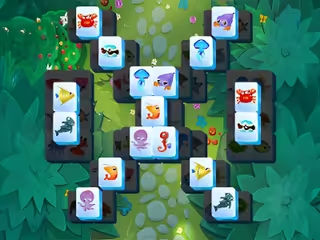
The tiles start in a stacked shape, several layers high. A tile is free when nothing sits on top of it and at least its left or right side is open. You remove free tiles in identical pairs:
- Find two free tiles with the same picture.
- Click both to remove them.
- Any flower tile matches any other flower, and any season matches any season.
- You win when the board is empty. You lose when no free pair is left.
Lockard’s 1981 game turned this idea into a hit, and a 1986 home-computer version sold around ten million copies. The five-level Turtle layout it made famous is still the default board in most mahjong solitaire games today.
Five habits that win more mahjong solitaire games
- Open the long rows first. The tiles at the ends of the longest horizontal rows hold back the most tiles behind them.
- Dig into tall stacks early. A tile buried under three layers can trap its partner for the whole game.
- Take all four at once when you can. If all four copies of a tile are free, removing them is never a mistake.
- When three copies are free, choose carefully. Remove the pair that opens up more of the board, and leave the third tile where it blocks the least.
- Do not grab the first pair you see. Before each move, ask what it unlocks. A slower pair that frees a stack beats an easy pair on the edge.
Which one should you learn?
- Pick four-player mahjong if you want a social game. It shines around a table with friends, and that is exactly what the current boom is about.
- Pick mahjong solitaire if you want a calm solo puzzle you can finish in ten minutes. It is also a painless way to learn the tile designs before your first mahjong night.
Many people end up doing both: solitaire on the phone during the week, the real game with friends on the weekend.
Play mahjong solitaire free
All of these run in your browser, with no download and no sign-up:
- Mahjong Classic: the traditional game on boards like Turtle, Fort and Dragon. Every layout it deals has a solution, and there is no timer.
- Mahjong Solitaire Unlimited: endless levels with a relaxed mode and a timed mode for when you want pressure.
- Daily Mahjong Challenge: a cute, gentle take with no clock at all. A good first game.
- Mahjong Master: hints, shuffle and undo, handy while you build the habits above.
If you would rather collect sets the way the four-player game does, try Tile Stack Mahjong, where you build groups of four matching tiles. You can browse more tile and board games in Card & Board.
Sources
- Mahjong solitaire, Wikipedia
- American mahjong, Wikipedia
- Why Mahjong is surging in popularity, NPR, April 2026