How to Play Checkers: Rules, Kings and 5 Beginner Tips
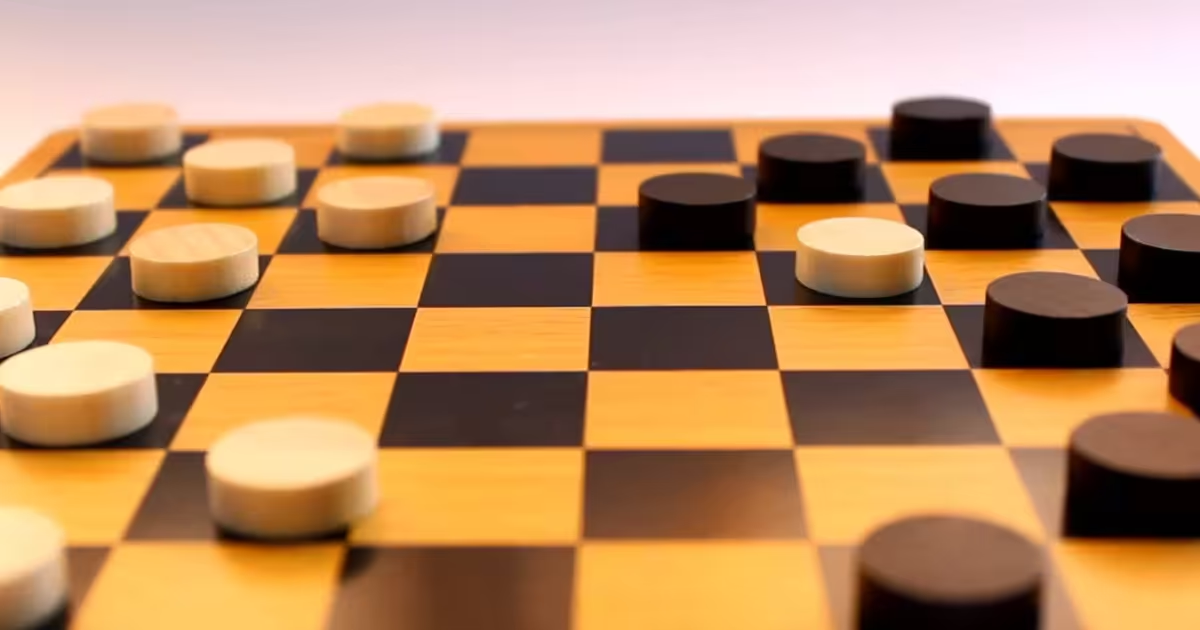
Checkers is a two-player board game played on the dark squares of an 8×8 board. Each player starts with 12 pieces, moves them one square diagonally forward, and captures by jumping over an opponent’s piece. Reach the far side of the board and your piece becomes a king that can move backwards too. You win by capturing all of your opponent’s pieces or leaving them with no legal move.
These are the standard rules of American checkers, also called English draughts, the version on most boards in the US and the UK. You can try every rule as you read in English Checkers, which plays exactly by these rules against the computer or a friend.
Quick answers
Who goes first in checkers?
The player with the darker pieces moves first. On a black-and-red set, that is usually black; on a red-and-white set, red.
Do you have to jump in checkers?
Yes, under the official rules. If you can capture, you must, although you may choose which capture to make when there is more than one. Many casual players ignore this rule, so agree on it before you start.
Can a regular piece move backwards?
No. Ordinary pieces only move and capture diagonally forward. Only kings can move backwards.
How do you win checkers?
Capture all of your opponent’s pieces, or block them so they have no legal move on their turn. If neither player can win, the game is a draw.
The board and setup
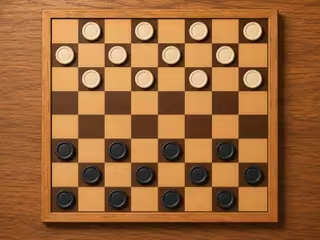
- Use an 8×8 board of 64 alternating light and dark squares. All play happens on the dark squares.
- Each player has 12 pieces, placed on the dark squares of the three rows closest to them.
- The two middle rows start empty.
How pieces move
On your turn, move one piece one square diagonally forward onto an empty dark square. Pieces never move straight ahead or sideways, and they never land on light squares.
How to capture (jumping)
If an opponent’s piece sits diagonally next to yours and the square right behind it is empty, you can jump over it into that empty square. The jumped piece is removed from the board.
- Multi-jumps: if, after landing, another jump is available, you keep going in the same turn. A single piece can capture two, three or more pieces in one move.
- Forced captures: under the official rules, you must take a capture whenever one is available. This is the rule that creates most of the tactics in checkers, because you can offer a piece to force your opponent into a position where you then jump two.
Kings
When one of your pieces reaches the far row on your opponent’s side, it is crowned: put a second piece on top of it to show it is a king.
- A king moves and captures diagonally forwards and backwards, still one square at a time.
- If a piece reaches the far row in the middle of a multi-jump, it is crowned and the turn ends there.
In other versions of draughts, such as international draughts on a 10×10 board or Russian draughts, kings can fly any distance along a diagonal. In American checkers they cannot.
How the game ends
- Win: your opponent has no pieces left, or has no legal move on their turn.
- Draw: both players agree, or the same position keeps repeating with neither side able to make progress.
5 tips that beat most beginners
- Keep your back row as long as you can. Your opponent needs to reach that row to crown a king. Two pieces left on your back row can guard it for most of the game.
- Fight for the centre. Pieces in the middle of the board have two forward moves and support each other. Pieces on the edge are hard to capture, but they only have one direction to move.
- Move pieces in pairs. A piece with a friend diagonally behind it can’t be jumped from the front, because the landing square is occupied.
- Use forced captures. Because jumps are compulsory, you can sacrifice one piece to pull an opponent’s piece into a spot where you then take two. Before every move, look at which jumps your opponent will be forced to make next.
- Trade when you are ahead. Swapping one piece for one piece helps the player with more pieces, because the gap matters more as the board empties. When you are behind, avoid even trades.
Is checkers a solved game?
Yes. In 2007, researchers at the University of Alberta used the program Chinook to prove that checkers ends in a draw when both players make no mistakes. It took nearly two decades of computer calculation. For human players the game is still full of traps, because nobody plays perfectly.
Checkers or chess first?
Checkers has one kind of piece and one way to move, so most children and new players can learn it in a few minutes, and it still teaches the habit of looking a move ahead. If you are deciding between the two, read chess vs checkers: which to learn first.
Play checkers online
Start with English Checkers to practise the official rules, or Classic Checkers for quick matches. Free Checkers lets you switch between American, Russian, Portuguese and Brazilian rules, and Checkers by fireplace offers small boards that are good for beginners. For more two-player classics, see the classic board games page, or learn a counting game with our guide on how to play Mancala.