Times Tables Games: Learn Every Table in Order
The fastest way to learn the times tables is not to start at the 2s and march up to the 12s. Learn the easy tables first, give each remaining table one trick, and you will find that only six hard facts are left: 6 × 6, 6 × 7, 6 × 8, 7 × 7, 7 × 8 and 8 × 8. Practise for about ten minutes a day, spread across the week, and finish with a game so that the facts have to come from memory rather than from a chart.
This guide gives the order, the tricks and a simple routine, with the multiplication games on this site matched to each stage.
Quick answers
In what order should children learn the times tables?
Start with the 1s, 10s, 2s and 5s, which can be built from counting. Add the 4s, 3s and 9s next. Leave the 6s, 7s and 8s for last: by then almost every fact in them is already known from an easier table.
How many times table facts are there to learn?
A 10 × 10 table has 100 facts, but 3 × 7 and 7 × 3 give the same answer, so there are only 55 different facts. Extend the table to 12 × 12 and that becomes 78. Swapping the order halves the work: a child who knows 3 × 7 already knows 7 × 3.
At what age should a child know their times tables?
In the US, the Common Core standards expect children to recall every product of two one-digit numbers from memory by the end of grade 3, roughly ages 8 to 9. Multiplication is introduced a year earlier through equal groups, so grade 2 is the time for counting in steps.
How long should a practice session be?
Short and often. Research on spaced practice finds that spreading study across several days helps people remember longer than the same time spent in one sitting. Ten minutes a day beats an hour on Sunday.
The order that works
| Stage | Tables | Why this group |
|---|---|---|
| 1 | 1s, 10s, 2s, 5s | Counting in steps: the answers are numbers children already say aloud. |
| 2 | 4s, 3s, 9s | Each has a quick trick built from stage 1. |
| 3 | 6s, 7s, 8s | Most of these facts repeat a fact from stages 1 and 2. |
Here is why stage 3 is smaller than it looks. Suppose a child knows every fact for 0, 1, 2, 3, 4, 5, 9 and 10. Then 6 × 3 is just 3 × 6, 7 × 9 is the 9s table, 8 × 5 is the 5s table, and so on. What is left is every fact that involves only 6, 7 and 8:
- 6 × 6 = 36
- 6 × 7 = 42
- 6 × 8 = 48
- 7 × 7 = 49
- 7 × 8 = 56
- 8 × 8 = 64
Six facts. Write them on a card and keep it on the fridge.
One trick for every table
| Table | Trick | Example |
|---|---|---|
| × 10 | Put a zero after the number. | 10 × 7 = 70 |
| × 5 | Halve the × 10 answer. | 5 × 8 is half of 80, so 40 |
| × 2 | Double the number. | 2 × 7 = 14 |
| × 4 | Double, then double again. | 4 × 6: 6 → 12 → 24 |
| × 8 | Double three times. | 8 × 6: 6 → 12 → 24 → 48 |
| × 3 | Double, then add one more group. | 3 × 7 = 14 + 7 = 21 |
| × 9 | Take the number from the × 10 answer. | 9 × 7 = 70 − 7 = 63 |
| × 6 | Use the × 5 fact and add one more group. | 6 × 7 = 35 + 7 = 42 |
| × 7 | Split into 5 and 2 groups. | 7 × 8 = 40 + 16 = 56 |
Two extra memory hooks help with the stubborn ones. The answers from 9 × 1 to 9 × 10 always have digits that add up to 9 (18, 27, 36, 45 and so on), which is a handy way to check an answer. And the numbers 5, 6, 7, 8 in order give you 56 = 7 × 8, a fact many people find slippery. For more shortcuts, including multiplying larger numbers by 9 and 11, see our post on mental math tricks.
A 10-minute daily routine
- Two minutes of warm-up on tables the child already knows. Quick wins set the mood.
- Five minutes on one new table, using its trick out loud: “6 × 7 is 5 × 7, which is 35, plus 7 more, which is 42.”
- Three minutes of a game that mixes the new table with old ones.
Each day, swap in a different table, and bring back an older one every few days. The point of the spacing is that a fact has to be recalled after a gap, and recalling is what makes it stick.
Which game for which stage
All of these play free in the browser, with no download.
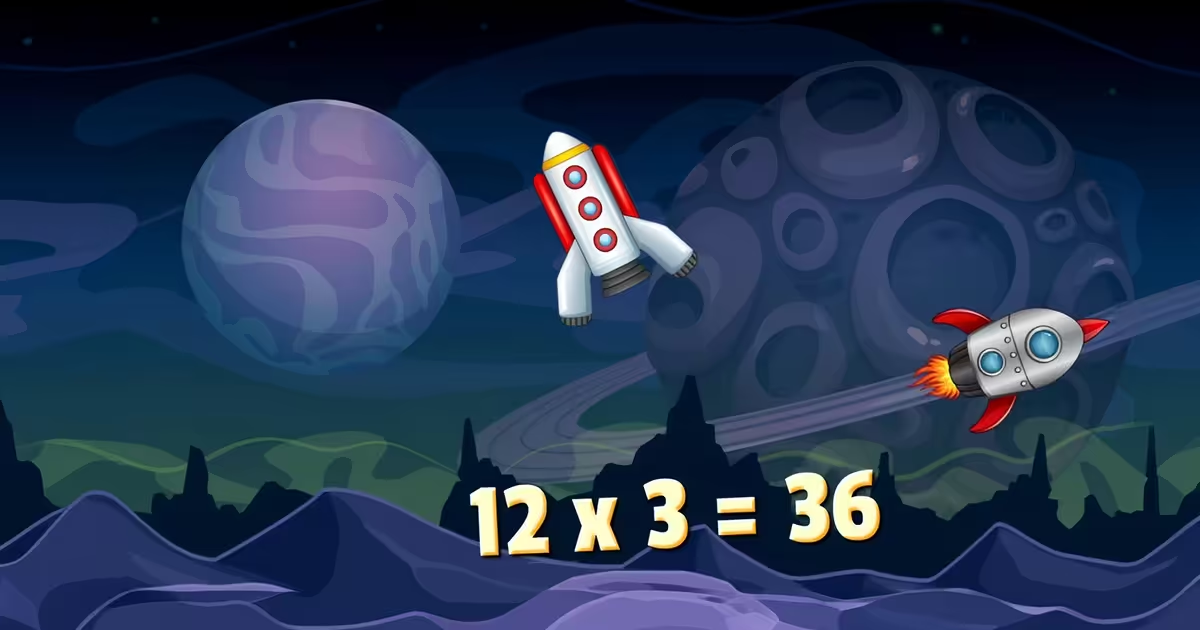
- Learning a new table: Math Rockets Multiplication. Tap the rocket that carries the right product. There are eight levels of ten problems, and picking from a few answers builds confidence before speed matters.
- Understanding that facts connect: Planet Explorer Multiplication. You see four multiplications and must find the one whose result is different. Working out all four teaches that 6 × 4 and 8 × 3 land on the same number.
- Recalling quickly: Math Racing 2 Multiplication asks you to drive through the gas can whose problem equals your car’s number, and Math Charge Multiplication asks you to enter the product of the problem on an enemy submarine and fire.
- Low-pressure fun with a story: Math Zombie Rodeo Multiplication adds a timer and coins, while Luminara Multiplication is a puzzle platformer where answering a multiplication question unlocks the day-and-night switch you need to reach the bone.
Once multiplication feels solid, turn the same facts around. If 6 × 7 = 42, then 42 ÷ 7 = 6. The division games on the same page practise exactly that.
Common questions
My child knows the facts at home but freezes in a timed game. Drop the timer for a week and use the pick-the-answer games, then bring speed back gradually. Speed comes after accuracy.
Is it fine to count on fingers? Yes at first, especially for the 9s. The goal is that the fingers get used less each week, not that they are banned.
Should we learn 11s and 12s? After the 10 × 10 table is secure. The 11s are simple up to 9 × 11, and 12 × 7 is easiest as 70 + 14.
Sources
- Common Core State Standards, Grade 3, Operations and Algebraic Thinking, standard 3.OA.C.7: thecorestandards.org
- Cepeda, Pashler, Vul, Wixted and Rohrer (2006), “Distributed practice in verbal recall tasks: A review and quantitative synthesis,” Psychological Bulletin 132(3): PubMed