Spider vs Klondike vs TriPeaks: Solitaire Rules & Strategy
“Solitaire” isn’t one game. It’s a whole family of single-player card games, and the three most popular ones play very differently. Klondike is the classic most people grew up with, Spider is the long, deep puzzle for patient players, and TriPeaks is the quick one you can finish in a couple of minutes. Here’s how each works, which is hardest, and the strategy that wins more deals. All of them are free to play on MathLogic.
At a glance
| Klondike | Spider | TriPeaks | |
|---|---|---|---|
| Cards | One 52-card deck | Two decks (104 cards) | One 52-card deck |
| Goal | Build four suit piles from ace to king | Build eight king-to-ace runs in one suit | Clear three peaks of cards |
| Key rule | Stack down in alternating colors | Stack down in any suit; move only same-suit runs | Play a card one rank above or below |
| A game takes | 5–10 minutes | 10–20 minutes | 2–3 minutes |
| Luck vs skill | Mixed | Mostly skill | More luck, quick decisions |
| Best for | Everyone | Patient planners | Short breaks |
Klondike: the classic
How it works. Twenty-eight cards are dealt into seven columns, from one card up to seven, with only the top card of each face up. The rest form the stock. Cards on the table stack downward in alternating colors — a black 5 on a red 6 — and the aim is to move every card to four foundation piles, one per suit, from ace to king. Only a king, or a run starting with a king, can fill an empty column. Depending on the version you draw one or three cards from the stock at a time; drawing three is harder.
Strategy that wins more games:
- Uncover face-down cards first. Every hidden card is a card you can’t use. When you have a choice, make the move that flips a card, and favor the longest columns because they hide the most.
- Don’t send everything to the foundations. Aces and twos are always safe to move up, but a black 6 may be the only place for a red 5 you’ll need later. Keep middle cards on the table until they’ve done their job.
- Only empty a column when a king can use it. An empty column is useless until a king arrives, so clearing one without a king ready often wastes a move.
- Pick the right twin. If two red 7s could go on your black 8, move the one that uncovers a face-down card.
Not every deal of Klondike can be won, even with perfect play, so a loss isn’t always a mistake. Play it in Klondike: Classic Solitaire, which has no timer and includes hints and undo, or in Solitaire Klondike: Eternal Russian Classic with a Russian-style deck.
Spider: the thinker’s solitaire
How it works. Spider uses two decks. Fifty-four cards are dealt into ten columns (six cards in the first four, five in the rest), with the top cards face up, and the other fifty wait in the stock. You can place any card on one that is one rank higher, in any suit, but you can only move a group of cards together if it’s a run of one suit. When you complete a full run from king down to ace in a single suit, it leaves the table. When you’re out of moves, deal a new row — one card on every column. Clear all eight runs to win.
Difficulty depends on the number of suits: one suit is relaxing, two is a real challenge, and four is one of the hardest solitaires around.
Strategy that wins more games:
- Build in suit whenever you can. A 6 of hearts on a 7 of hearts can move later; a 6 of hearts on a 7 of spades is stuck in place. Mixed-suit stacks are sometimes necessary, but treat them as temporary.
- Empty columns are gold. Any card can go into an empty column, which makes it the best tool for untangling a stack. Don’t fill one just because you can.
- Make every useful move before dealing. A new row drops a card on every column and can bury what you were working on. In many versions you also can’t deal while a column is empty.
- Expose face-down cards. As in Klondike, a hidden card is a lost option.
For a twist, try Cards: Spider Solitaire Millennium. Completed runs go back into the deck and may return as a different suit, so a one-suit game gradually becomes a four-suit one.
TriPeaks: fast and addictive
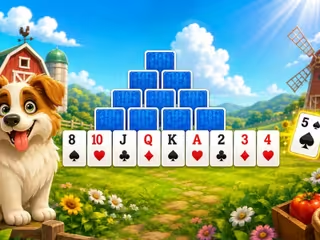
How it works. Twenty-eight cards are laid out in three overlapping peaks, and the rest form a stock with one card turned face up. You can take any uncovered card from the peaks that is one rank higher or lower than that face-up card, whatever its suit — a 5 or a 7 on a 6. The card you take becomes the new face-up card, so you can build long chains: 6, 7, 8, 7, 6… When nothing fits, turn over the next stock card. Clear all three peaks before the stock runs out.
Strategy that wins more games:
- Look for the longest chain, not the first play. Before you move, trace a few possible chains and choose the one that removes the most cards.
- Free face-down cards. When two cards could continue your chain, take the one that uncovers another card.
- Don’t flip the stock too early. Every stock card you turn is one less rescue later.
TriPeaks usually comes with level maps and bonuses. Happy Farm Solitaire adds a farm journey, boosters and undo, and Spooky Tripeaks has 100 Halloween levels with jokers.
What about FreeCell?
FreeCell is the other famous solitaire. All cards are dealt face up, and four “free cells” hold single cards while you rearrange the columns. Because nothing is hidden, it’s almost pure skill: of the 32,000 deals in the original Microsoft version, only one is known to be unwinnable. If you enjoy Spider’s planning, FreeCell is worth a try. Solitaire Pro Plus bundles 125 kinds of solitaire if you want to explore beyond the big three.
Which solitaire should you play?
- New to solitaire? Start with Klondike. The rules are simple, and the strategy tips above make a real difference quickly.
- Want a long, deep puzzle? Play Spider with one suit, then move up to two and four as you improve.
- Only have a few minutes? TriPeaks is perfect for a quick round.
Whichever you pick, solitaire is a quiet way to practice planning and patience — the same skills behind logic and strategy games. Shuffle up and deal.