How to Play Minesweeper: Rules, Patterns & Tips for Beginners
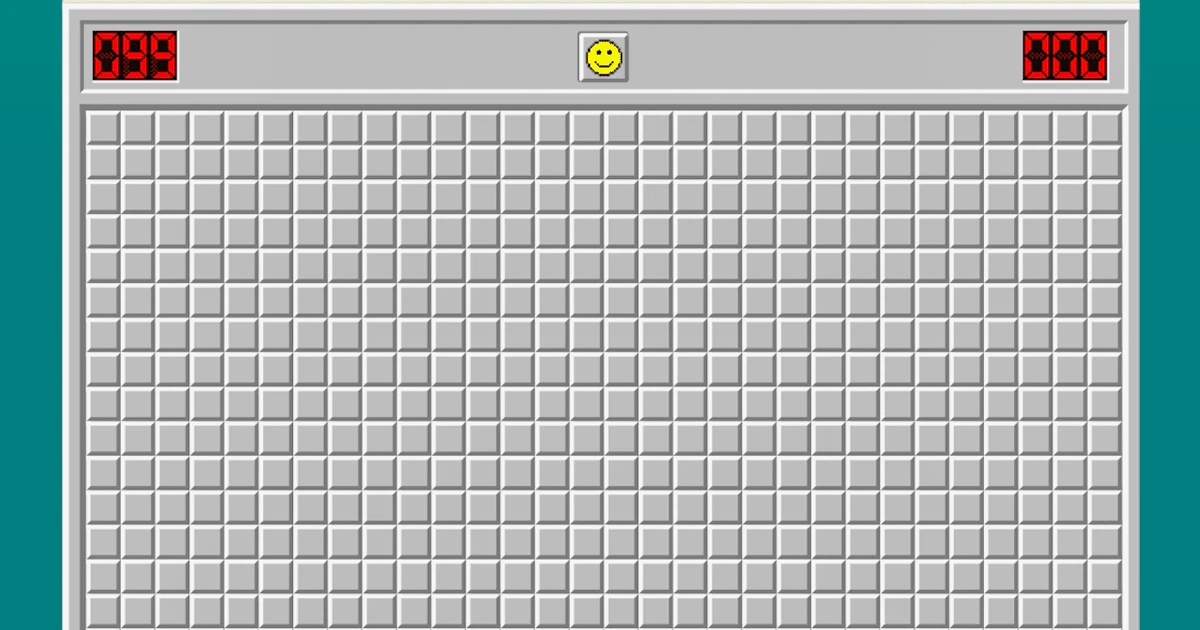
Minesweeper is a logic puzzle played on a grid of covered squares. Some squares hide mines; the rest are safe. You open squares one at a time, and every safe square shows a number: how many mines touch it. Read those numbers to deduce where each mine is, flag the mines, and uncover every other square to win. Open a mine and the game is over.
That is the whole game. The rest of this guide shows you how to read the numbers, how to make a good start, and the handful of patterns that let you clear most boards without guessing. You can follow along in our free classic Minesweeper in another tab, and find every version we have on the Minesweeper games page.
Quick answers
How do you play Minesweeper?
Click a covered square to open it. Each number counts the mines among the eight squares around it. Use the numbers to find the mines, flag them, and open all the other squares to win.
What do the numbers mean?
Each number counts the mines in the squares around it: up, down, left, right and the four diagonals. A 1 means exactly one of those squares is a mine. A blank square means none of its neighbours is a mine, so the game opens them all for you.
How do you flag a mine?
On a computer, right-click a square to put a flag on it. On a phone or tablet, most versions use a long press or a flag button that switches taps between opening and flagging. Flags are only reminders for you; the game does not check them until the end.
Can your first click be a mine?
In most modern versions, no. The game places the mines after your first click, or moves a mine away, so the first square is always safe.
How do you win?
Open every square that is not a mine. You do not have to flag the mines to win, although flagging helps you keep track.
Reading the board
Here is a small corner of a board in the middle of a game. Numbers are opened squares and the grey squares are still covered:
| 1 | 1 | 2 | |
| 1 | |||
| 1 |
The 1 in the top-left corner touches only one covered square, the grey one diagonally below it. Its count is 1, so that square must be a mine. Now look at the 1 to its right and the 1 below it. Both already touch that mine, so each of their other covered neighbours is safe. One mine and two safe squares, found from three small numbers.
Almost all of Minesweeper comes down to two rules:
- If a number touches exactly as many covered squares as its value, all of them are mines.
- When all the mines around a number are flagged, its remaining neighbours are safe.
Your first game, step by step
- Choose Beginner. A 9 × 9 board with 10 mines is the right size to learn on. Intermediate and Expert come later.
- Open a square near a corner or in the middle. You need a lucky first area to get going; corners slightly more often open a blank region because they have fewer neighbours.
- Look along the edge of the opened area. That border, where numbers meet covered squares, is where all the information is.
- Find a number with only one way to be true. A 1 touching a single covered square, or a 2 touching exactly two, gives you mines for certain. Flag them.
- Open the squares those mines make safe. Each new number gives you more to work with.
- Repeat until the board is clear. If you reach a point where nothing is certain, read the section on guessing below before you click.
Five patterns that solve most boards
Experienced players do not count every square. They recognise shapes. Each diagram below shows a straight edge: the top row holds opened numbers and the grey row under it holds the covered squares directly beneath them. A dark square is the wall, 💣 is a mine, ✅ is safe and ? is not yet known.
1. The 1-1 against a wall. When a 1 sits next to a wall and another 1 follows it, the mine is in the first two squares, so the third square is safe.
| 1 | 1 | ||
| ? | ? | ✅ |
2. The 1-2. A 2 next to a 1 always has a mine on its far side. The 1 allows at most one mine in the two squares they share, so the 2 needs its second mine in the square only it can see, and the square only the 1 can see is safe.
| 1 | 2 | ||
| ✅ | ? | ? | 💣 |
3. The 1-2-1. Mines sit under both 1s and the square under the 2 is safe. This is two 1-2 patterns facing each other.
| 1 | 2 | 1 |
| 💣 | ✅ | 💣 |
4. The 1-2-2-1. Mines under both 2s, and the squares under the 1s are safe.
| 1 | 2 | 2 | 1 |
| ✅ | 💣 | 💣 | ✅ |
5. Subtract what you already know. A number with flags next to it behaves like a smaller number. A 3 with one flagged neighbour is really a 2 for the squares that are still covered, a 2 with one flag is really a 1, and so on. Reduce the numbers first and the four patterns above appear everywhere, even in the middle of the board.
Why patterns 3 and 4 work, and what to do when no pattern fits, is covered in our article on whether Minesweeper is luck or skill.
Tips to get better and faster
- Work the border, not the whole board. Only squares touching a number tell you anything. Scan the edge of the opened area and ignore the covered middle.
- Clear safe squares as soon as you find them. Every new number may solve the area next to it.
- Use chording. In many versions, clicking a number that already has the right number of flags around it opens all its other neighbours at once. It saves a lot of clicks on bigger boards.
- Do not flag everything. Flags are useful while you learn, but fast players often flag only where it helps them think.
- Watch the mine counter near the end. When few squares are left, the total number of mines remaining can settle a corner that the local numbers cannot.
- Move up one level at a time. Beginner (9 × 9, 10 mines), then Intermediate (16 × 16, 40 mines), then Expert (30 × 16, 99 mines). Each step adds more of the patterns above.
When you have to guess
Most boards can be solved by logic, but not all. Sometimes two squares hide one mine between them and the numbers give you no way to choose. When that happens, guess early rather than after an hour of work, and pick the square with the lowest chance of hiding a mine. If you would rather never guess at all, try Explainable Minesweeper: every board it makes can be solved by logic, and its Hint button explains the reasoning for the next safe move.
Where to practise
- Minesweeper: the classic, with the retro Windows look and Beginner, Intermediate and Expert levels.
- Explainable Minesweeper: no-guess boards and explained hints, ideal while you learn the patterns.
- Minesweeper Infinite: a Classic mode plus an Endless mode that keeps the board going, great for drilling.
- Minesweeper Duel: two players take turns opening squares and scoring their values.
All four are free in the browser on computers, tablets and phones. For more puzzles built on pure deduction, see our logic puzzles.